
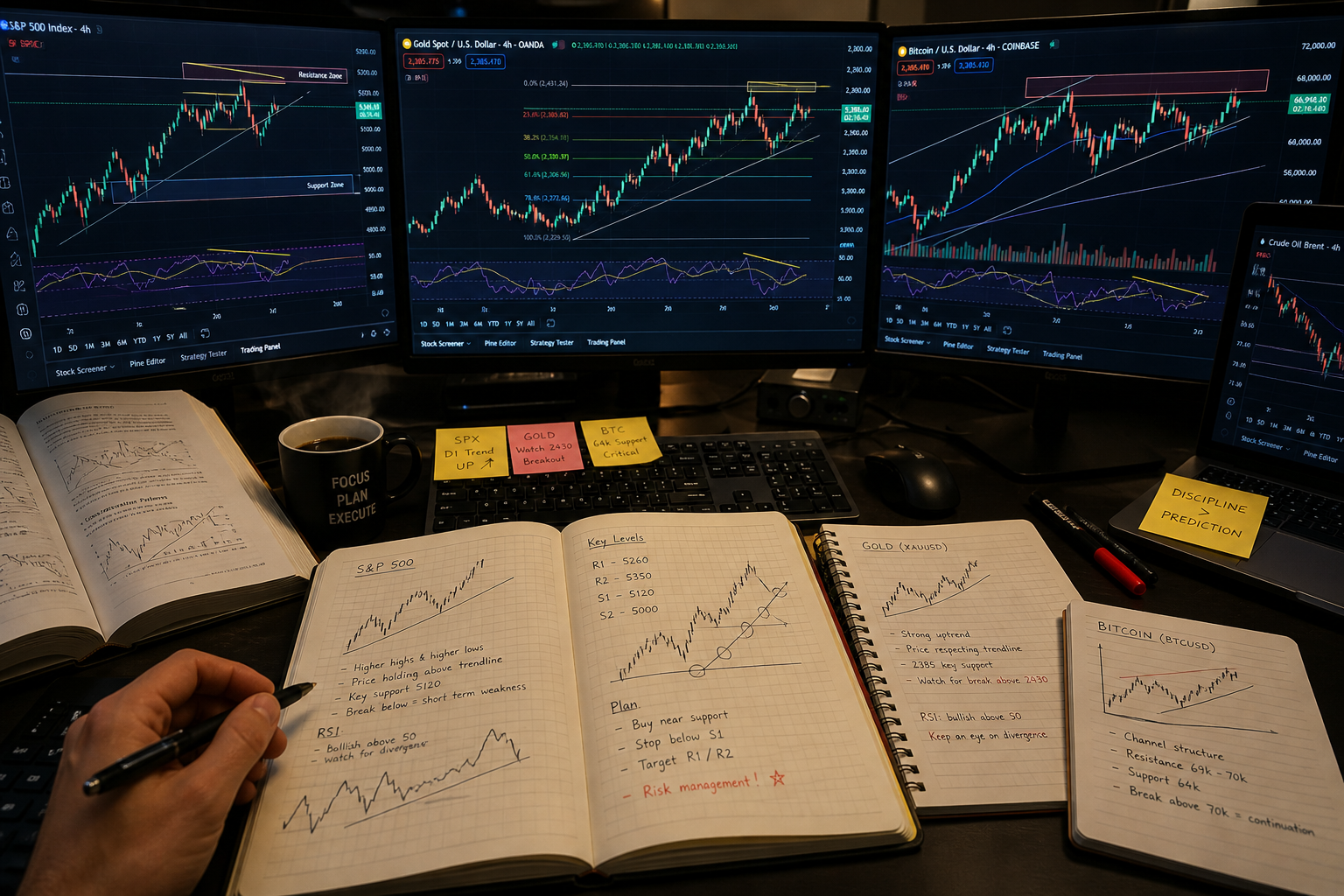
Financial markets are complex, dynamic, and often difficult to interpret. Yet within every chart lies a structured record of market behaviour – a visual history of price, momentum, and sentiment. Educational technical chart analysis is the discipline of reading that record objectively, using proven analytical frameworks to understand market structure and identify key technical levels.
This guide explains how technical analysis works, what it measures, and how Chartrick’s team of experienced technical analysts applies it across global equities, commodities, and cryptocurrency markets.
All content in this guide is educational technical chart analysis provided for informational purposes only. It does not constitute investment advice or any recommendation to buy, sell, or hold any financial instrument.
What Is Technical Analysis?
Technical analysis is a method of evaluating financial markets by studying historical price data, chart patterns, and indicator signals. Unlike fundamental analysis – which assesses a company’s earnings, revenue, or macroeconomic data – technical chart analysis focuses exclusively on what the chart itself reveals about market structure and price behaviour.
The central premise is straightforward: price reflects all available information. Every piece of news, every institutional decision, every shift in sentiment is ultimately expressed through price movement. By analysing the patterns and structure within that price movement, technical analysts work to understand the current state of the market and what the chart is communicating.
Chartrick’s approach is built entirely on this foundation. Every piece of analysis published on the platform is grounded in publicly available market data and delivered strictly as educational technical chart analysis.
The Core Building Blocks of Technical Chart Analysis
Understanding how technical analysis works begins with mastering its foundational components. Chartrick’s methodology is structured around four core elements:
1. Trend Structure
A trend is the directional bias of price over time. Technical analysts identify three primary trend states:
- Uptrend – a sequence of higher highs and higher lows, indicating sustained buying pressure
- Downtrend – a sequence of lower highs and lower lows, indicating sustained selling pressure
- Consolidation (sideways) – price moving within a defined range, indicating a period of equilibrium between buyers and sellers
Trend identification is the starting point for all technical chart analysis. Before interpreting indicators or drawing support and resistance levels, it is essential to establish the prevailing trend structure and directional bias across the relevant timeframes.
Chartrick’s analysts examine trend structure on both daily and weekly timeframes to build a complete picture of where a market currently stands within its broader cycle.
2. Support and Resistance Levels
Support and resistance levels are among the most important concepts in technical chart analysis. They represent price zones where markets have historically demonstrated a tendency to react – either by halting a decline (support) or capping an advance (resistance).
- Support levels are price zones where buying interest has previously emerged, preventing further price decline
- Resistance levels are price zones where selling pressure has previously emerged, capping upward price movement
These levels are not arbitrary lines. They are derived from historically significant price points – previous swing highs and lows, Fibonacci retracement levels, prior consolidation zones, and technical indicators such as moving averages and Bollinger Bands.
In Chartrick’s structured market analysis, key technical levels are always presented with specific price values, clearly identifying which levels are above current price (resistance) and which are below (support).
3. Market Behaviour Patterns
Technical analysts study recurring patterns in price behaviour. These patterns include:
- Breakout structures – price moving decisively beyond a defined support or resistance level
- Pullback structures – temporary retracement within an existing trend before continuation
- Consolidation structures – price contracting into a defined range before the next directional move
- Reversal structures – price forming a pattern that suggests the prevailing trend may be changing direction
Identifying these structures allows technical analysts to contextualise price movement within its broader market behaviour framework, rather than interpreting individual price bars in isolation.
4. Multi-Timeframe Analysis
A single chart captures one perspective. Multi-timeframe analysis involves examining the same market across multiple timeframes – for example, the weekly chart for macro trend context and the daily chart for near-term structure.
When the directional bias across multiple timeframes aligns, the technical signal carries greater analytical weight. When timeframes conflict, the technical picture becomes more complex and warrants additional scrutiny. Chartrick’s daily analysis routinely incorporates both daily and weekly chart perspectives to provide a complete technical context for each market covered.
Technical Indicators: RSI, Bollinger Bands, and Volume
Technical indicators are mathematical calculations applied to price and volume data to generate additional analytical signals. They do not replace price analysis – they supplement it. Chartrick’s methodology incorporates three primary indicators across all markets:
RSI (Relative Strength Index)
The Relative Strength Index (RSI) is a momentum oscillator that measures the speed and magnitude of recent price changes. It produces a value between 0 and 100.
- RSI readings above 70 are conventionally associated with overbought conditions – indicating rapid upward price movement that may be extended
- RSI readings below 30 are conventionally associated with oversold conditions – indicating rapid downward price movement that may be overextended
- RSI divergence – where price makes a new high or low but RSI does not confirm – is a technically significant signal that analysts examine for potential momentum shifts
It is important to note that overbought and oversold RSI readings do not automatically constitute reversal signals. In strongly trending markets, RSI can remain at elevated or depressed readings for extended periods. RSI analysis is always conducted in conjunction with price structure and trend context.
Bollinger Bands
Bollinger Bands consist of three lines plotted on a price chart: a 20-period simple moving average (the middle band), and an upper and lower band set at two standard deviations above and below the middle band.
- The upper Bollinger Band represents a statistically elevated price level relative to recent history
- The lower Bollinger Band represents a statistically depressed price level relative to recent history
- Bollinger Band width reflects market volatility – bands expand during periods of high volatility and contract during periods of low volatility
The middle Bollinger Band (the 20-period moving average) frequently acts as a dynamic support or resistance level, particularly during trending market conditions. Chartrick’s analysts identify the middle Bollinger Band as a key level with a specific price value in each daily structured market analysis.
Volume Analysis
Volume measures the number of units traded in a given period. It is one of the most informative yet frequently overlooked dimensions of technical chart analysis.
- Rising price accompanied by rising volume suggests strong market participation and conviction behind the price move
- Rising price on declining volume may indicate weakening momentum, with fewer participants supporting the advance
- High-volume candles at key support or resistance levels often mark significant price decisions and warrant specific analytical attention
Chartrick’s methodology treats volume analysis as a mandatory component of structured market analysis. Volume signals present in the analysis are always called out explicitly, as they provide critical context for interpreting the quality of price moves.
See These Principles Applied Daily
Chartrick’s expert analysts publish structured daily educational technical chart analysis across S&P 500, Gold (XAUUSD), Silver (XAGUSD), Brent Crude Oil, and Bitcoin (BTC).
What Technical Analysis Does Not Do
Understanding the limitations of technical chart analysis is as important as understanding its capabilities. This distinction is central to Chartrick’s educational philosophy.
- Technical analysis does not predict the future with certainty. It identifies probabilities and technical conditions, not guaranteed outcomes.
- Technical analysis does not produce buy or sell signals. It produces chart-based observations about market structure, momentum, and key levels.
- Technical analysis does not eliminate market risk. Financial markets are complex systems subject to sudden shifts driven by news, policy, and macroeconomic forces.
- Technical analysis is not a substitute for independent judgment. Every investor is responsible for their own decisions.
Every analysis published on Chartrick is framed within this educational context. The platform’s role is to present what the chart is communicating – not to advise on how investors should respond to that information.
How Chartrick Applies Educational Technical Chart Analysis
Chartrick’s team of experienced technical analysts applies a consistent, structured methodology across every market the platform covers. Each daily analysis follows a defined framework:
- Market overview – a brief assessment of current market conditions and the forces shaping recent price action
- Trend structure analysis – identifying directional bias, higher highs and lower lows, consolidation zones, and breakout or pullback structures
- Technical indicator interpretation – RSI momentum reading, Bollinger Band position and width, volume signal assessment
- Key technical levels – a clearly formatted list of specific support and resistance price levels, identified from chart structure
- Educational summary – a structured conclusion presenting the technical picture as it stands, without directional advice
This framework is applied consistently whether the asset being analysed is the S&P 500 (SPX), Gold (XAUUSD), Silver (XAGUSD), Brent Crude Oil, or Bitcoin (BTC).
Chartrick’s analysis is produced by experienced technical analysts with deep familiarity across equities, commodities, and cryptocurrency markets. All analysis is grounded in publicly available market data and published strictly as educational technical chart analysis.
Why Educational Technical Chart Analysis Matters for Investors
For investors seeking to understand financial markets, educational technical chart analysis provides a structured, objective framework for interpreting price behaviour. Rather than relying on sentiment, rumour, or media commentary, technical chart analysis offers a disciplined methodology grounded in observable market data.
The ability to read chart structure – to identify where a market is within its trend, what key technical levels lie ahead, and what indicators reveal about current momentum – equips investors with analytical context that is not available through headlines or earnings reports alone.
This is precisely the analytical context Chartrick is built to deliver. The platform exists to make high-quality, expert-level technical chart analysis accessible to a global audience of investors, in a form that is clear, structured, and entirely educational in nature.
Explore Chartrick’s Technical Chart Analysis Across Global Markets
Chartrick publishes expert educational technical chart analysis daily across five core markets:
- S&P 500 (SPX) – daily equity market technical analysis covering trend structure, key technical levels, and momentum indicator signals
- Gold (XAUUSD) – daily precious metals technical chart analysis covering price structure, Fibonacci levels, and Bollinger Band positioning
- Silver (XAGUSD) – daily technical chart analysis covering trend behaviour, momentum signals, and key support and resistance levels
- Brent Crude Oil – daily energy market technical chart analysis covering price structure, trend direction, and critical chart levels
- Bitcoin (BTC) – daily cryptocurrency technical chart analysis covering market cycle positioning, trend structure, and key chart levels
Need Technical Chart Analysis for a Specific Asset?
Request educational technical chart analysis, for any Equities, Commodity, or Cryptocurrency and Indices delivered within 2 working days.
Understanding Technical Analysis: Key Takeaways
Educational technical chart analysis is a disciplined, structured approach to interpreting financial market behaviour through price data, chart patterns, and indicator signals. Its core components – trend structure, support and resistance levels, RSI, Bollinger Bands, and volume analysis – work together to present a comprehensive technical picture of any market.
What technical analysis produces is not certainty. It produces structured, objective insight into the current technical condition of a market, the levels that matter, and what the indicators are communicating about momentum and participation. How investors choose to act on that context is entirely their own decision.
Chartrick’s mission is to make that level of structured technical insight accessible, educational, and free from the kind of directional framing that crosses into investment advice. Every analysis published on the platform is built on that principle.
Decoding the Language of Charts.
Important Disclaimer
All content on Chartrick, including charts, analysis reports, articles, and educational materials, is provided for general informational and educational purposes only. Nothing on this platform constitutes investment advice, financial advice, trading advice, or any recommendation to buy, sell, or hold any financial instrument. Financial markets carry risk, and past chart analysis does not guarantee future performance. All analysis is based on publicly available market data and is subject to change at any time. While every effort is made to ensure accuracy, Chartrick does not accept liability for any loss, damage, or financial outcome arising directly or indirectly from use of or reliance on this content, including any errors or omissions in the analysis. Users are solely responsible for their own investment and trading decisions and should exercise their own independent judgment.